5 Modern Fundraising Ideas Inspired by Great Design

Written by

the Acton Circle Team

/

Updated

October 13, 2025

Donors see dozens of campaigns each week. Most blur together into one indistinguishable ask. A few stand out.

And the ones that are designed around how donors see, feel, and move through the message.

When your campaign invites donors INTO a story instead of ASKING them for money, the way they engage completely changes. They stay longer and explore more. They understand the value of their gift without having to work for it.

As you rethink your year-end fundraising (with belief-building design in mind), think about how simplicity, flow, and emotive messaging can help donors move from aware to action.

These five modern fundraising ideas borrow from product design, brand storytelling, and the simple patterns that make digital experiences feel effortless.

Here's how to apply that thinking to your next campaign.

→ Click here to download our free Canva donor thank-you postcards

Simplify the Act of Giving (A Modern Fundraising Essential)

Sometimes the smartest fundraising idea is the simplest one: make giving feel effortless.

Think of your donation page like a great app—focused, fast, and frustration-free.

  • Remove clutter
  • Cut optional fields
  • Use one clear CTA
  • Make mobile the default

Simplicity is persuasive. If giving feels smooth, donors stay in the moment. They don't second-guess themselves.

Quick test: Donate to your own campaign on mobile. If it feels tedious, donors will feel it too.

Use Motion to Carry Emotion in Your Fundraising Campaigns

Small moments of motion can guide donors through your story:

  • A progress bar that fills as gifts come in
  • A hover effect that reveals an impact stat
  • A gentle loop that brings your mission to life
  • A micro-animation that signals confirmation or success

Motion draws the eye. Emotion keeps them with you. Together, they're one of the most underrated modern fundraising ideas.

Visual Fundraising Ideas That Show the Change Donors Help Create

When donors can SEE the difference they're making, they act faster and with more confidence.

Replace long paragraphs with visual storytelling:

  • Impact cards
  • Before-and-after moments
  • Clean infographics (with context)
  • Short story snippets
  • Thoughtful photography

Keep in mind, you're not removing depth. You're removing friction.

People understand well-designed visuals in a single glance. When donors get the clarity they need fast, they're way more willing to give.
Get The Annual Report Checkpoint
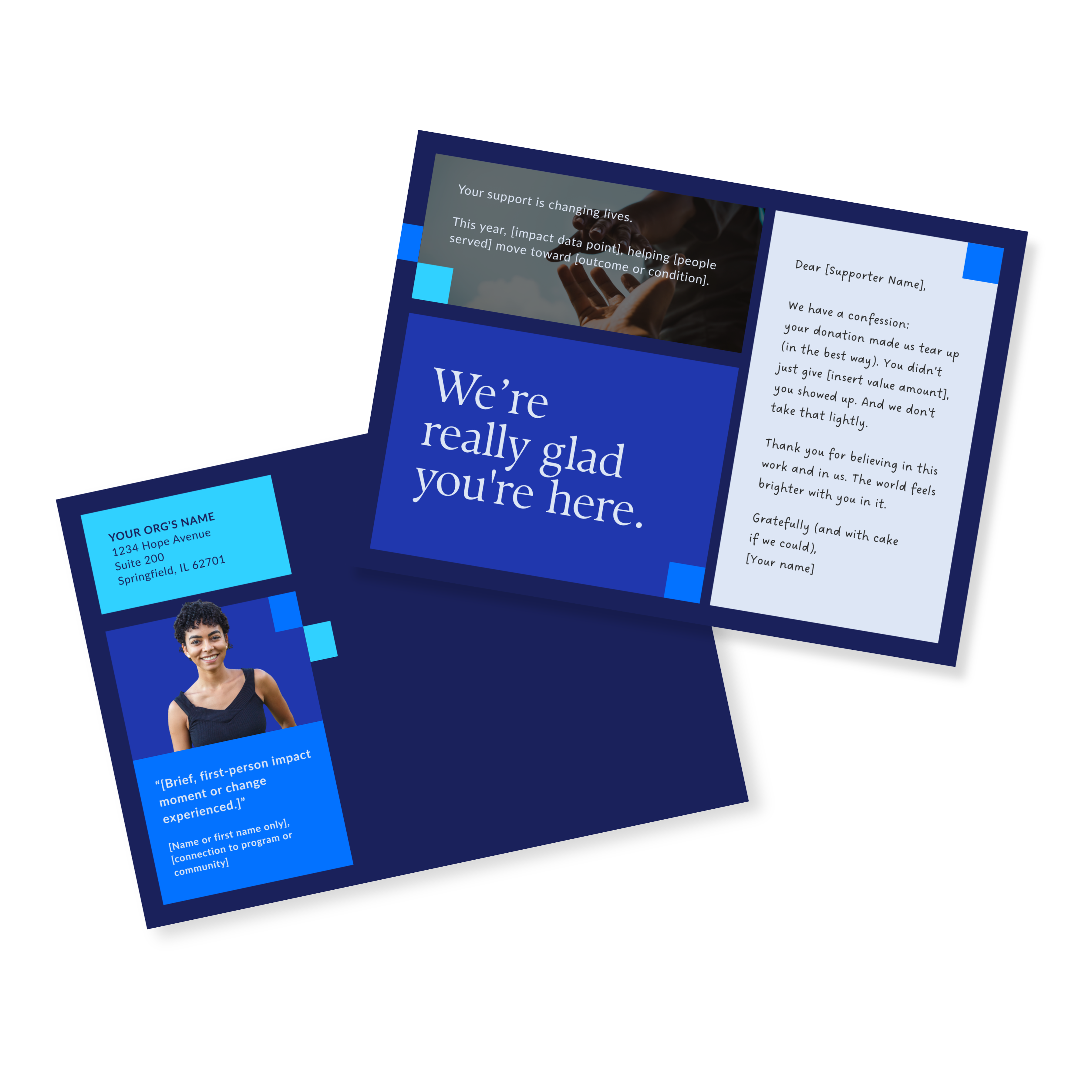
Donor Thank You Postcards Templates

Enter your info and we’ll send the postcards straight to your inbox:

Bring Real People Forward in Your Fundraising Storytelling

Every great fundraising idea starts with a face and a feeling. Polished stock photos can soften reality and dilute emotion. Real people bring your mission into sharp focus.

Your donors respond to honesty. The kind that shows up in:

  • One quote that says more than a paragraph
  • One moment that reveals what's at stake
  • One story that distills your mission
  • One image that captures the heartbeat of your work

Thoughtful design keeps your content engaging by making it easy to read, easy to follow, and quick for donors to absorb.

Build a Community People Want to Belong To

A strong fundraising campaign doesn't exist in isolation. Donors experience your brand across dozens of touchpoints, and they make sense of it through consistency.

When your:

  • emails
  • social graphics
  • landing pages
  • donation pages
  • annual reports

…all share the same visual language, donors don't have to work to understand where they are or what you're asking. They feel like the experience makes sense.

That familiarity does the work most nonprofits skip. It builds trust in what they're looking at.

Trust is what guides donors through your campaign because the experience feels calm, clear, and like someone thought it through.

Advertisement for Canva Donor Thank-You Postcards offering four ready-to-use templates with a download button.

Monthly Design Workshop

If you’re the one who usually handles design at your org, this is meant for you. You’ll leave with useful design tips you can start using right away.

see upcoming sessions
👋🏽 Hi, I'm Krista Reyes

I'm a writer and editor with almost a decade of professional experience. I spent most of my formative years working with local and international nonprofits, channeling my passion for worthy causes into written works with depth, value, and intention.

If I'm not working, you'll find me reading books, watching movies, playing chess, or bonding with my four dogs.

👋🏽 Hi, I'm Olivia Wheeler

I'm a creative leader with high standards for nonprofit storytelling. I work between homeschooling and gym sessions, obsess over typography, and believe your annual report should make supporters feel your mission in their bones.

I help nonprofits connect with new audiences and look like the org they're becoming, not the ones they were five years ago.

Annual report lessons most nonprofits learn the hard way

Why only 1 in 4 donor ever gives again

Your annual report is a stewardship and retention tool waiting to be used.

Most orgs treat it like a formality. Design it, ship it, forget it. Then wonder why the same donors don't show up again next year.

Donors leave because nobody showed them their gift mattered after they gave it.

First-time donors are THE MOST fragile group you have. One good report = a second gift.

We wrote about exactly how to use your annual report as a stewardship tool, not just a recap: Your Annual Report Is a Stewardship Tool. Here's How to Actually Use It That Way.

Why only 1 in 4 donor ever gives again

Great work along does not raise money

Programs don't fund themselves. Understood value does.

You can run the best program in your sector and still lose funding, because funders and donors don't fund what you did. They fund what they understood.

Most impact sections list activities. Meals served, kids reached, hours logged. None of that tells anyone what changed.

The gap isn't your work. It's the translation between your work and what the reader actually feels reading about it.

I broke this down here: How to Measure Your Nonprofit's Impact (And Make Sure It's Felt)

Great work along does not raise money

Where donors stop reading

Donors give you a few seconds before they decide if your report is worth their time.

Dense pages, no hierarchy, and nothing to pull the eye to what matters don't help.

I wrote about what actually earns attention in that window here: Annual Report Layout: Tips for a Report Donors Will Read

Where donors stop reading

A faster way to build your report

So you're doing your annual report solo again this year, huh? Same deal as last time: last year's PDF open in one tab so you can copy the bones, and a blank Canva doc that doesn't carry a single thing over.

A template is the thing that should've existed the first time you did this solo.

Here's a better approach to your report if you're handling it in-house: The Faster Way to a Beautiful Annual Report

A faster way to build your report

What you're not pulling from your own report

Your annual report is the most content-rich thing your org makes all year. And then it just sits on your website.

Real stories, real numbers, real proof your mission works, all sitting in one PDF that gets opened once and forgotten.

That same content could be twelve LinkedIn posts, three newsletter sends, a case study, a slide for your next pitch deck. Every one of those keeps your mission in front of donors between asks, not just during them.

More on how to make your report work past launch day: Simple and Flexible Annual Report Ideas for Busy Nonprofits

What you're not pulling from your own report

Explore more articles

Donor Engagement
A great donor communication plan builds belief from day one. Let's talk about how to build it, design the materials around it, and implement it.
Donor Engagement
A donor stewardship plan is only as good as what your donor actually sees. Here's how to build one, with real donor stewardship examples by segment.
Donor Engagement
A report informs. An experience builds belief. Here’s how to make your annual report do the thing that funds the year ahead.