A development director told me recently that her annual report was keeping her up at night.
Not the budget or the board meeting. Getting the report done and out the door.
I sat with that for a second because it’s wild how much pressure one PDF can put on. But I wasn’t surprised. I hear some version of it on almost every call with potential clients. The report gets pushed to the bottom of the list, rushed at the end, and then the end result is a bit disappointing.
If that’s where you are, I get it.
Most people have no idea what they’re really saying yes to when they start looking into annual report design services. They picture someone who takes their Word doc, makes it pretty, and sends back a file. That’s not the work. At least, not when it’s done well.
What Great Annual Report Design Services Do
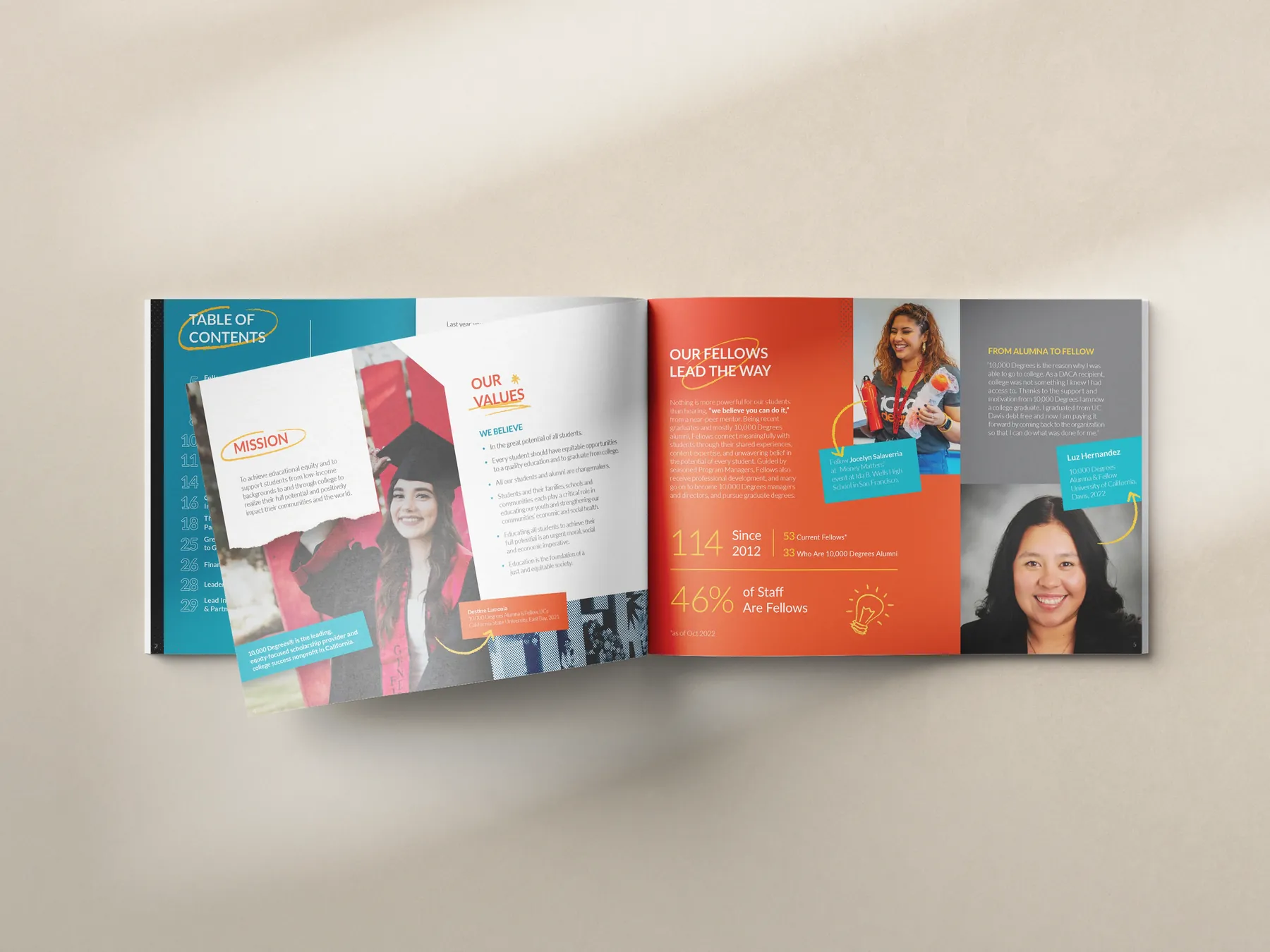
Here at Acton Circle, we firmly believe that your annual report is a belief-building tool. It’s the piece a donor opens before they read a single word, and in about half a second, decides whether your org looks like one worth backing.
Humans are wired this way. We scan a room for safety before we ever sit down. Your donors are doing the exact same thing with your report.
So when you bring in an annual report design agency, you’re not buying decoration. You’re buying what makes a donor feel safe putting their money toward your mission.
That’s why good annual report design services start with strategy and story. The design comes second. Every time.
So here’s what you should expect when you work with us:
What to Expect #1: A Thought Partner, Not Just a Pair of Hands
This is the first thing teams want to know, and it’s a fair question. Are you hiring a brain or just hands?
One client put it to me directly on a call: “When we’re in meetings with you, do we come with the vision and you implement it? Or are you a thought partner in building it?”
Thought partner. Always.
You might come in with a clear vision, and I’d never discredit that. But you’ll also hear me ask, “Have you thought about it this way?” or “Why are we leading with the stat instead of the person?”
That second set of eyes from someone who’s sat alongside 60+ nonprofit teams is the most valuable.
If all you wanted was someone to execute exactly what you say, you’d hire the cheapest freelancer you could find and still have your hands all over it. That’s not delegation. It’s babysitting. And I don’t know about you, but if I’m gonna babysit, it better be my own kids.
Expect to be challenged a little. In a good way.
What to Expect #2: A Full Collaboration, Not a Finished Script to Execute
Here’s the fear underneath a lot of I’m-not-ready-yet hesitation: people think they need to show up with a finished draft, a theme, a title, and a folder of perfect photos.
You don’t. You need something to work from. A rough draft. A pile of stories and stats. A general sense of how you want it to feel. But not everything.
One client came to us worried because their impact lived in narrative, not numbers. “How do you prove impact without data?” she asked.
That’s not a disadvantage, but a gift. So many reports are a wall of stats with no human in sight, and I’m always pushing the other way anyway. A number with no story is just a number a donor has no relationship to.
So expect to be asked one question early: what did your donor’s money do for a real human being?
Answer that plainly, and we build everything else around it. You don’t need the theme figured out. That’s literally part of what you’re paying for.
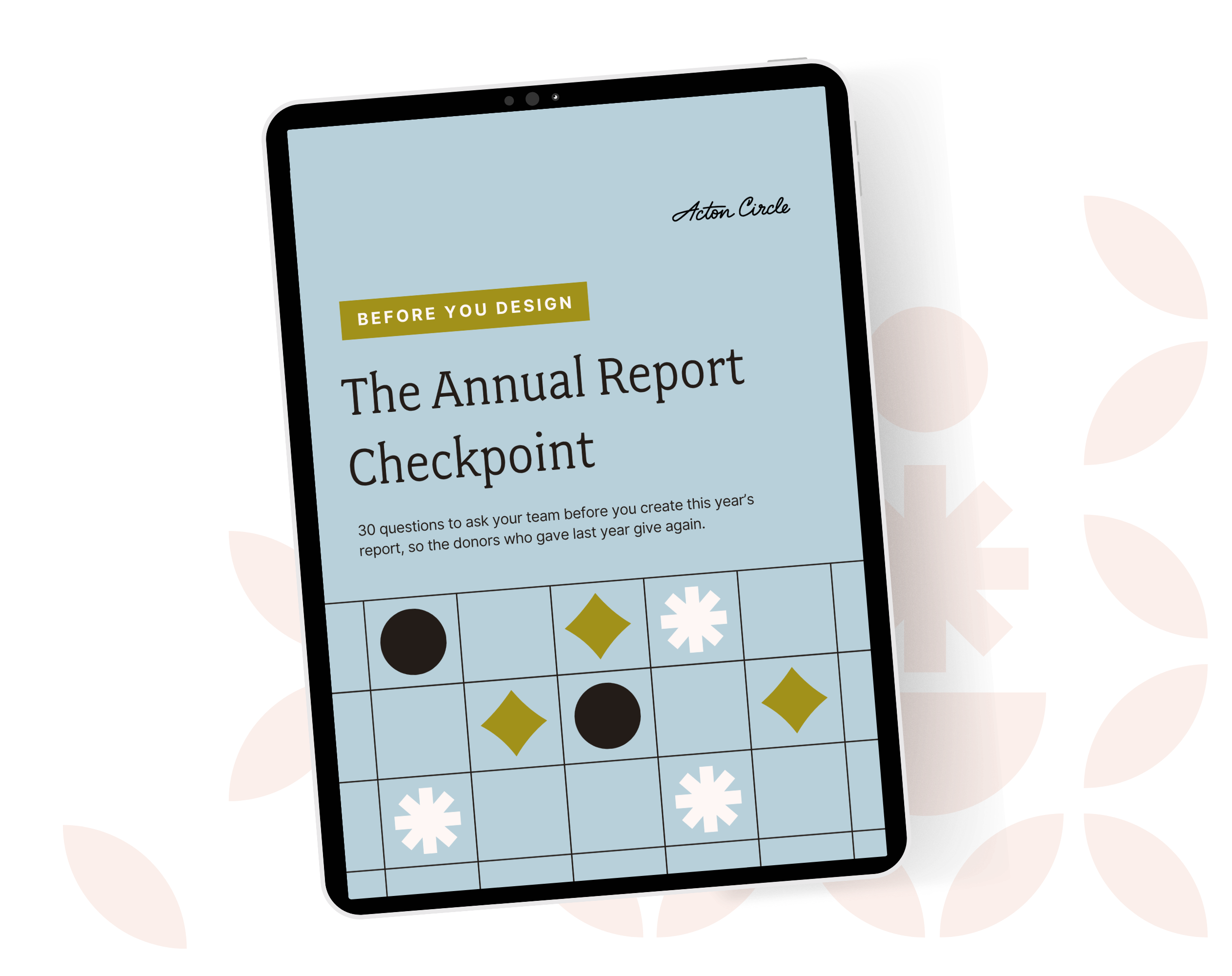
Get The Annual Report Checkpoint
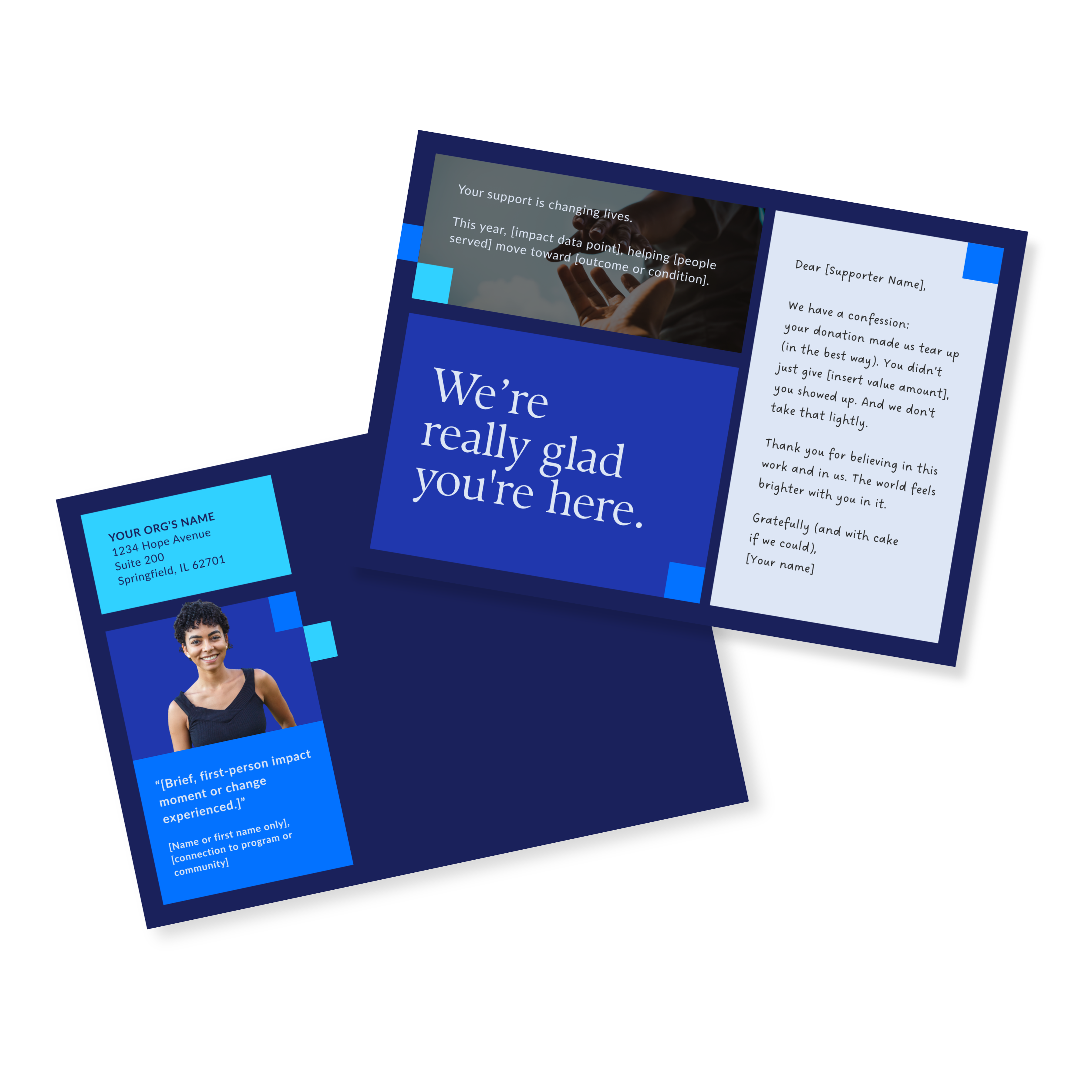
Donor Thank You Postcards Templates
Enter your info and we’ll send the postcards straight to your inbox:
What to Expect #3: A Process That Moves in Stages (Nothing Is a Surprise)
This is the part that surprises people most, so let me lay it out plainly. Annual report design services that lead with strategy usually move through clear stages, and you’ll see your report at every one.
→ Story and copy first: We get clear on the narrative. What we lead with, what we cut, and the one thing a donor should walk away remembering. If you need writing support, it happens here.
→ The wireframe: We lay out the whole report in black and white so you can feel the story build before we make a single design decision. You won’t catch yourself three rounds in, staring at the pretty version, but realizing that the flow was off the whole time.
→ Initial design concepts: We lock in the look of the cover and a few key spreads. We get aligned on your design preference before going full-send on all 24 pages in a direction you don’t love.
→ Full design, then your final edits: Everything you need to be publish-ready, handed to you neatly and on time.
→ Repurposed assets: More on this in a minute, because most teams sleep on it.
Feedback is built into every stage. You’ll mark up a Google Doc for copy and use our review tool to comment directly on the designs. You’ll see what we’re doing and why, and you can say “keep going” or “that’s not what we meant.”
Our process runs async with recorded walkthroughs, plus a call whenever it’s faster to just talk it out.
One more thing to expect: We’ll ask you to name one point person. Nonprofits love design-by-committee, I know. But one decision-maker is what keeps the whole project from going sideways.
What to Expect #4: Something That Looks Like You (Not Last Year’s Corporate Template)
The worry here is two-sided. Some teams just went through a rebrand, and the report still comes out uninspiring. Others are working with materials that feel a decade old. Either way, the fear is the same: will this thing reflect who we are right now?
One client said it perfectly. Last year’s report was “a little buttoned up, a little corporate,” and they wanted to break out of that this year. Pop a little more. Tug on the heartstrings. Feel like the nonprofit they truly are.
Expect us to study your brand, your past reports, the way you talk on your website, and then build something that makes your board look at it and think “yes, that’s us.”
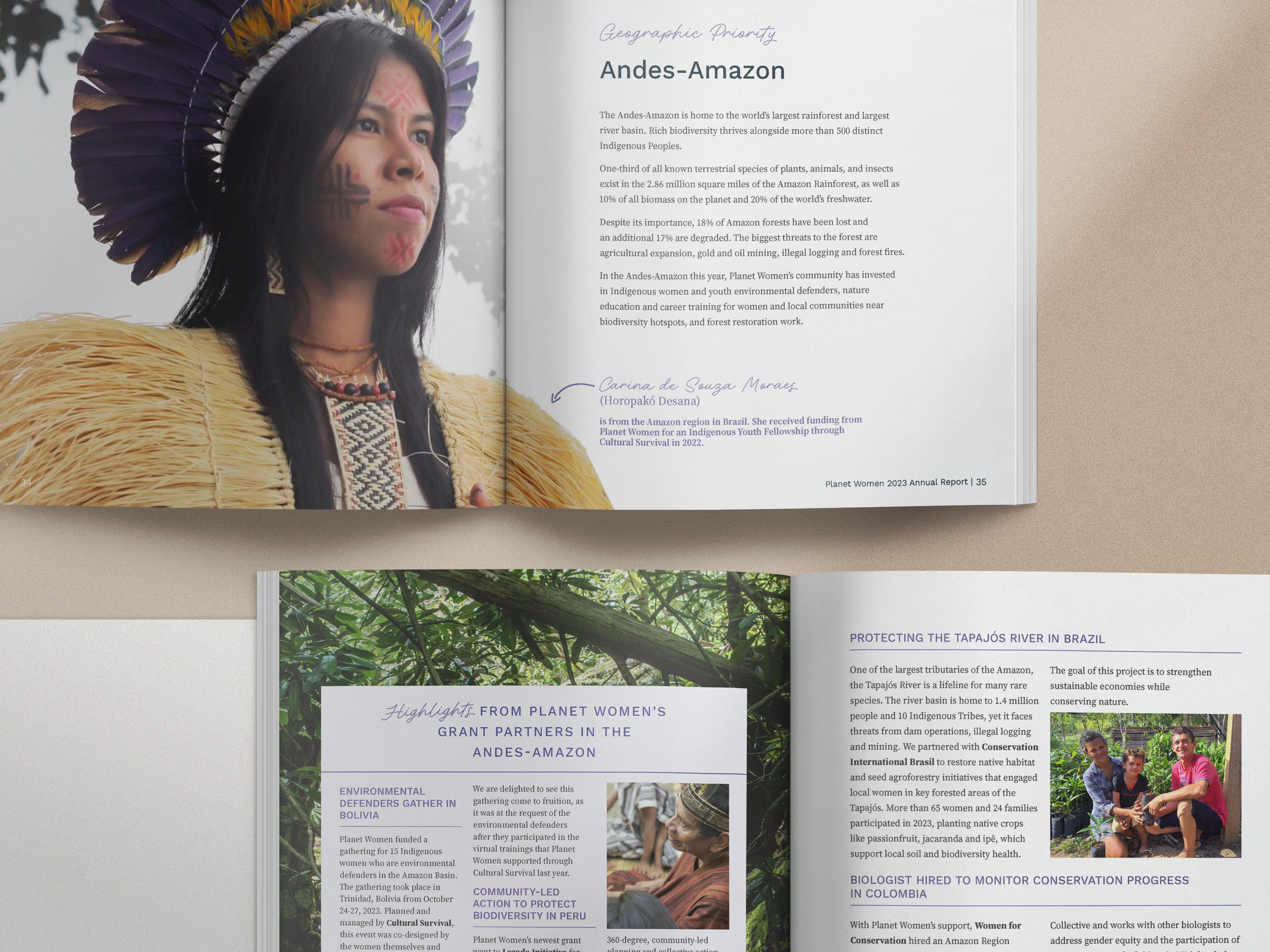
With Planet Women, we took a report that came in a bit too corporate and brought their texture and earthiness back through photography and design finishes. That piece became the foundation for the rest of their comms.
Another client told me her old report “doesn’t do the organization justice.” That sentence is the whole reason our annual report design services exist.
What to Expect #5: A Report That Keeps Working After Launch
Please don’t let this become a one-and-done PDF.
You’re creating a polished, story-rich piece of content from scratch. Letting it sit on your website afterward is leaving money on the table.
- Impact stats become your year-end appeal
- Donor quotes become social proof
- Program highlights become funder slides
Same content, new outfit.
A good annual report design agency designs for this from the start, with modular layouts and reusable pieces, so your team isn’t building from zero every time they need something donor-facing.
Also, so many reports have no CTA at all (which always blows my mind). That’s a whole donor conversation left on the table.
We want to give your report a job. A real call to action, something trackable, like a QR code or a dedicated landing page so you actually know if it’s meeting your goals (like for real, for real).
.png)
“We Were Going to Do This Ourselves” and Other Things I Hear That Are Worth Questioning
“We were going to do this in-house.”
Almost every team I talk to was. One client told me, “Up until two weeks ago, we were going to do this ourselves.” She’d done the report five years running.
Doing it yourself was never the wrong call. You did what you had to do with the capacity you had. That’s a team of one (or two) wearing eleven hats and getting it across the line every year.
But getting the report out and getting the report right are two different things. The space between them is where donors stop paying attention.
“We don’t really have the budget for this.”
I hear this one a lot. And what’s usually underneath it is a comparison: the cost of a well-designed report versus the cost of doing it yourself. What’s missing from that math is the cost of donors only giving once, missed grants, and a team that’s a little embarrassed to share the thing.
If budget is genuinely the constraint, that’s exactly what our Annual Report System is for. Donor-aware layouts built specifically for annual reports, so you can DIY without starting from scratch.
“We only have a few weeks.”
A report with real breathing room (review cycles and time to get the story right) starts two to three months out. Maybe four. If you want to release in the Fall before year-end giving, for example, your start date is June.
If you’re already in the weeds? It can still be done. But expect an honest conversation about what’s possible, not a “yes” that sets us both up to fail.
“Our data is all stories, not numbers.”
Good. Lead with the stories. The stat-heavy report with no human in it is the harder problem to fix, and it’s the more common one. Translating lived experience into something a donor feels is the whole point. That’s not a gap in your data. It’s your advantage.
What a Home Run Looks Like
When I ask teams what success looks like, the best answer I ever got came in three parts, and I think about it all the time.
Anyone who touches it knows we’re a serious org doing important work. Anyone who reads it feels connected, like our mission affects real people they know (not “those other people over there.”) And our own staff feels seen, validated, celebrated.
That last one gets overlooked constantly, and it’s the one that stays with me. The people doing the work deserve to open the report and feel proud they’re part of it.
That’s the standard. Not that you just got it out the door. A piece that makes a donor believe, makes a stranger care, and makes your team feel dang proud.
Your Next Step
The relief my client described (the pressure lifting before we’d even really started) is available to you, too. But it doesn’t come from the cheapest set of hands or from a generalist annual design agency (those that do annual reports as side quests, not the main thing). There, you’re client number 400, and you can feel it.
It comes from a real partner. Someone who’s in it with you, not just for you. Your mission is too important for another year of “... this isn’t it.”
If you read this and thought, “we need to do this differently,” the best place to start is a conversation.
Book a call and let's talk about this year's report: what you need it to do, where it fits your goals, and what working together would actually look like (process, timeline, investment, all of it).
If we're a fit, you'll know. If we're not, I'll tell you that too.