Most nonprofits treat their annual report like a required task. Get the numbers together, write a few impact stories, make it look decent, send it out. Check.
And that mindset is exactly why so many reports sit unread in donor inboxes.
The importance of an annual report isn’t the document itself. It’s what that document does for donor trust, stakeholder confidence, and your org's ability to keep and grow the people who fund your mission.
When it’s designed with intention, it does serious fundraising work. When it’s not, it confirms to donors that your org is fine but not remarkable.
Keep ready for what a well-designed annual report is doing for your org, and why it's worth getting right.
The importance of an annual report is donor trust
There’s a difference between a report that recaps the year and a report that builds belief. The first one tells donors what happened. The second one makes them feel like their investment was in good hands.
The design of your annual report is doing trust work before anyone reads a single word. The cover, the typography, the way your financials are laid out: all of it tells donors whether you’re an org worth continuing to bet on.
Your supporters aren't all reading for the same reason
Donors want proof their gift mattered. Board members want to see the big picture. Funders want evidence you're running a tight ship. And potential supporters just want a reason to show up.
In my experience, the reports that fall flat are almost always designed around internal priorities first.
The CEO wants the financials prominent. The program team wants their initiative featured. The board wants strategy front and center. All valid. But what donors care about gets buried.
Design for audience tiers:
- First-time readers: Hook them in the first two pages. A strong visual, a clear outcome stat, a face they can connect to.
- Existing donors: Show them what their support made possible. Named programs, real numbers, honest reflections.
- Board and leadership: Keep the financial and strategic sections clean and easy to navigate.
When the design serves the reader instead of the org, the org still wins.
The CCMO at Peninsula Family Service came to us with exactly this challenge—a 75th anniversary report that needed to speak to longtime supporters, board members, and new audiences all at once without losing any of them.
"It took very few revisions to reach the final product."
Lead with the story. Then prove it with data.
Leading with numbers and burying the narrative is one of the most common mistakes I see.
Your stakeholders don’t want a yearbook. They want a story with a beginning, a middle, and a sense of where you’re headed.
The strongest sections I see pair one clear outcome stat with a specific human story. That combination is what donors remember six months later when they’re deciding whether to support again.
A story-first sequence:
- Open with your mission and the defining moment of the year
- Use a beneficiary story to put a face on your outcomes
- Let data confirm the scale of what the story already showed
- Close with where you’re going, not just where you’ve been
Testimonials and staff voices aren’t soft extras. They’re the parts donors forward to their circles.
The CEO at Chiron Community Giving Foundation came to us with complex mental health research that needed to land with community partners and policymakers. The story had to carry the data, not compete with it.
"A beautiful job bringing our foundation's report to life. The visualized data and narrative were enhanced by the very professional graphic design services provided by Acton Circle."
Your design is signaling something whether you planned it or not
The cover, the color palette, the way your numbers are presented: all of it says whether your org operates with care and intention or whether the report was thrown together the week before the deadline (eek!).
People trust orgs that look like they have it together. Meaning your design is saying something about your org, whether you planned it or not.
What credibility-building design looks like in practice:
- Consistent colors and typography that reinforce your brand
- Negative space that gives readers room to process
- Visual hierarchy that tells them where to look first
- Charts and infographics that make data feel accessible, not overwhelming
None of that happens by accident. It requires a design system.
The annual report compounds over time
Orgs that put out consistently strong annual reports see something interesting happen around year three or four: donors stop questioning the investment and start increasing it. The report becomes proof that you show up every year.
In our experience working with nonprofit communications teams, the orgs with the strongest major donor relationships almost always have a history of strong annual reports. The report isn’t the only factor, but it’s a visible, recurring proof point that the org shows up with intention every year.
Every report either builds that confidence or chips away at it. No neutral option.
The VP leading marketing and storytelling at Making Waves Education Foundation worked with us across four consecutive annual reports. Each one built on the last—same design language, stronger story every year. Donors didn't just stay. They deepened.
"Olivia takes the time to really understand our nonprofit organization's mission as well as the goal, audience, and style for each project."
If you're not sure whether your current report is building that kind of compounding trust, the free Annual Report Checkpoint is a good place to find out.
Digital design expands your reach
Print still has a place, especially for major donor stewardship and board packets. But the reach of your annual report shouldn’t stop at whoever picks up a physical copy.
Digital-first design changes what’s possible:
- Clickable navigation so readers jump to what they care about
- Embedded video and audio that brings programs to life without adding pages
- QR codes that connect to donation pages or related content
- Social-ready graphics and quotes pulled directly from the report
Your annual report is a content system.
Every infographic, every quote, every outcome stat is a piece of content that can work for you all year long.
Distribution is where most reports go to die
You can develop the strongest annual report in your sector and still lose all of it to a generic email blast and a PDF nobody downloads.
Plan distribution at the same time you plan design:
- A personal email to major donors, not a mass send
- A board walk-through before it goes public
- Bite-sized social content that drives traffic back to the full report
- Print copies hand-delivered to key community partners
Great report, no distribution plan? Nobody sees it.
The Senior Creative Manager at Tides came to us because their annual impact storytelling needed to live beyond a PDF. Three years of interactive microsites later, their reports were reaching movement-aligned audiences in a way static documents never could.
"Olivia is extremely bright and had incredible ideas and insights for our project. Team was very responsive and easy to work with."
Get The Annual Report Checkpoint
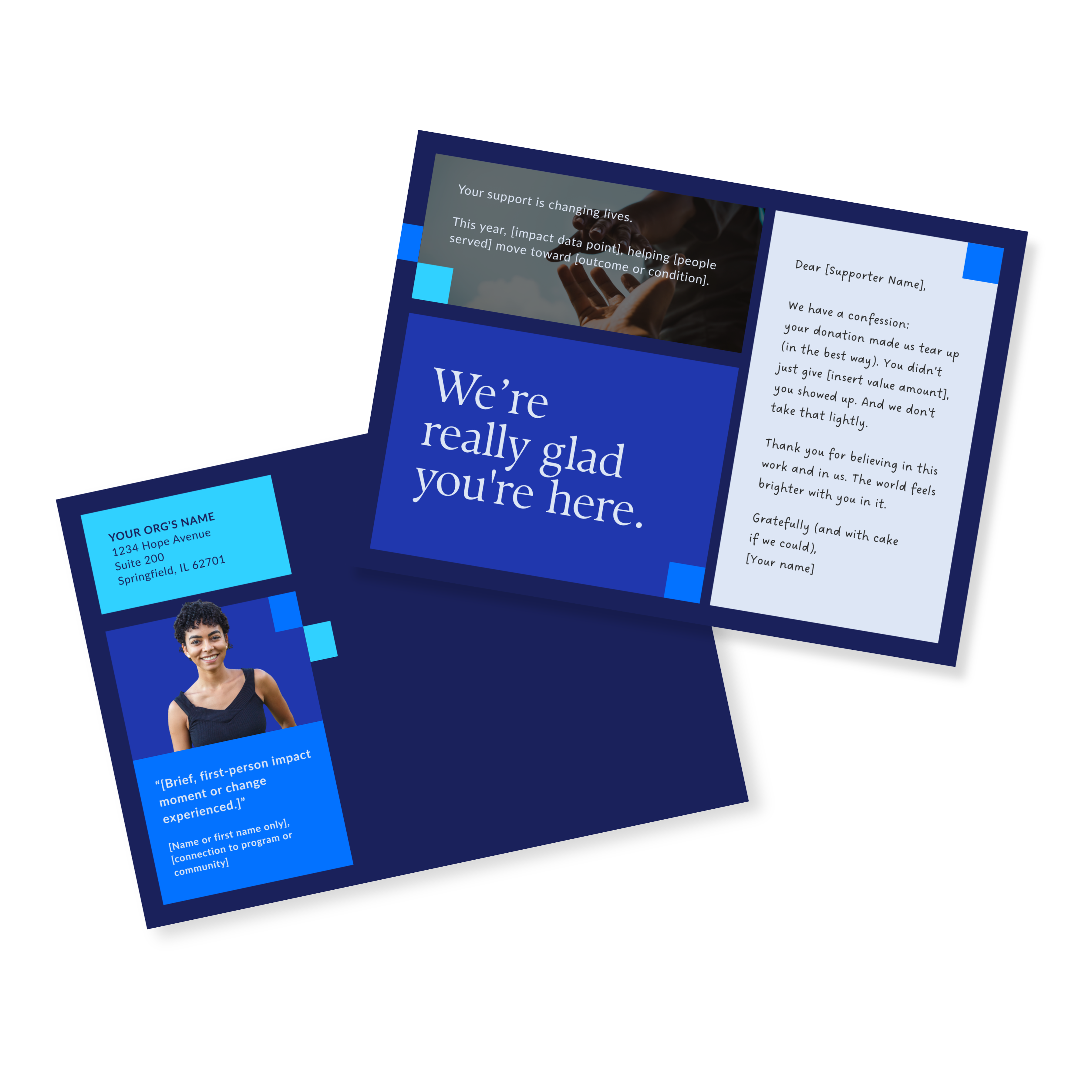
Donor Thank You Postcards Templates
Enter your info and we’ll send the postcards straight to your inbox:
Importance of an Annual Report FAQs
Why are annual reports important for stakeholders?
Your donors, board, and funders all have one question: is this organization worth my continued investment? Your annual report is how you answer it.
What is the importance of an annual report?
Your annual report is the one place where your finances, your impact, and your vision all live together. When it's designed well, supporters don't just understand your mission. They recommit to it.
Is it mandatory to send an annual report to shareholders?
For nonprofits it depends on your state and bylaws. Most funders require it anyway. But even when nobody's mandating it, a strong annual report is one of the best investments a comms team can make.
What is the primary reason the annual report is important?
Donor trust. Stakeholders, especially donors, need evidence that your org is operating transparently and producing real outcomes.
Is an annual report necessary?
Practically, yes. Skip it or phone it in and you'll feel it in donor retention and major gift conversations. It's one of the few times you have a stakeholder's full attention. Don't waste it, for real.
Find out if your report is doing its job
Every project I take on starts with one question: what do we need supporters to feel, and is the current report doing that work?
Most of the time the content is there. Good stories. Solid numbers. What's missing is the design and through-line that weave it all together.
That's exactly what the Annual Report Checkpoint helps you find. Take ten minutes and see where your report's gaps are before you invest another dollar in design.