In 2025, US giving hit a record $617.2 billion, but the number of donors continued to drop. Fewer people are sharing more of the load, which means every single one of them matters more than they did five years ago.
And the thing standing between you and them is whether your communications are recognizable, believable, and worth opening.
But for most nonprofits, the entire comms program is basically 50 generic emails, bi-weekly social posts that switch tones depending on who's posting, sporadic appeals here and there, and an annual report that goes out once.
That's a lot of sending, but not much actual communication.
The plan feels productive because there's so much to do, but it doesn't bridge the gap: a donor communication strategy that builds belief and creates enough trust for donors to continue giving.
Well, let's change that.
What Is Donor Communication?
Donor communication is the full set of messages an organization sends its supporters across the year: thank-yous, impact updates, newsletters, appeals, invitations, and reports. Delivered by email, mail, phone, text, social, and in person.
Its job is to keep a donor confident enough in your work to give again.
What is the difference between donor stewardship and donor communication?
Donor stewardship is what you do to build lasting donor relationships. Donor communication, on the other hand, is the material that relationship travels through. It's how you build and sustain that relationship.
You can have an excellent stewardship plan on paper and still lose donors because the material looks like it came from four different organizations.
Where does donor communication stand in 2026?
The numbers worth knowing, and worth quoting to your board:
- The average donor retention rate is 43.3%, only 0.2 percentage points up from the year before.
- Nearly 40% of nonprofits are experiencing reduced funding from individual donors and foundation funders.
- For organizations raising over $100,000 per year, funding dropped by around 6%.
- Accounting for inflation, the sector's total revenue decreased by 3%.
- 54% of donors say a nonprofit's website is the primary source they consult when deciding whether to give.
- 90% of donors are more likely to continue giving when they see clear proof of the impact of their previous donation.
These numbers tell us that more than half of your donors don't come back, and actual donor participation rates are in steady decline. At the same time, the numbers say that a trustworthy comms system can effectively sway people into giving.
Get The Annual Report Checkpoint

Donor Thank You Postcards Templates
Enter your info and we’ll send the postcards straight to your inbox:
The 5 Parts of an Effective Donor Communication Plan
Cover these, and you have a plan. Skip any, and you have a wish.
1. Goals
It's almost never about how often you communicate and more about how effective your communication methods are. "Communicate more" is never the goal.
So, look at your concrete numbers and decide the top three you want to improve. Retention, second-gift conversion, and upgrade rates are usually the three metrics a comms plan can move.
2. Segmented, actionable data
The good: Many nonprofits already know to include donor segmentation in their comms and stewardship strategy.
The bad: Most nonprofits stop at segmentation.
Tracking and organizing your donor tiers shouldn't just be about record-keeping. It should be the first step to figuring out a plan for every donor type.
If your strategy says "personalize by segment" but doesn't specify what personalization looks like, that's a plan that'll never see the light of day.
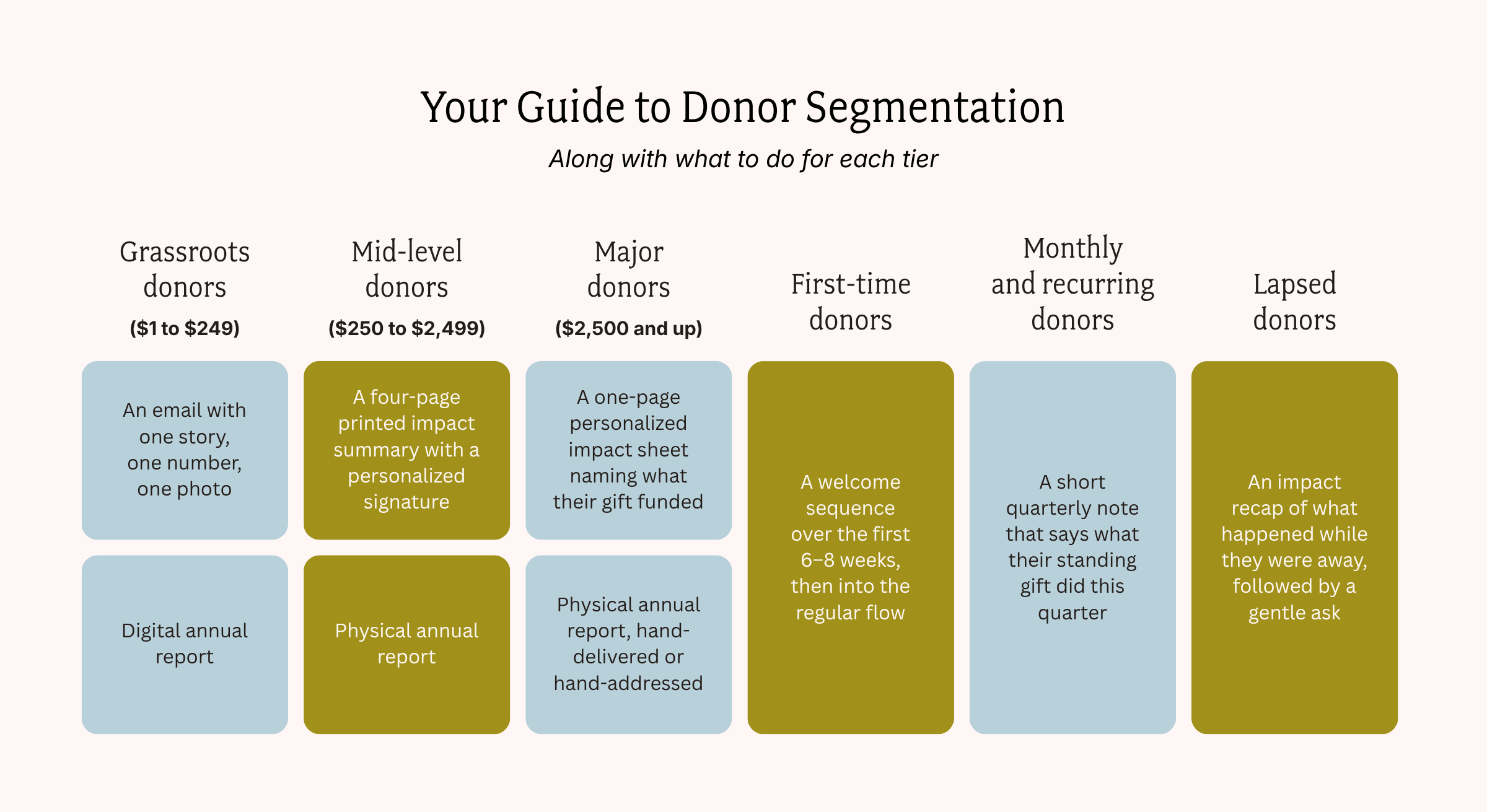
Instead, segment your donors into six, and remember how each differs:
- Grassroots donors ($1 to $249): The goal is a second gift, so make the ask small and specific.
- Mid-level donors ($250 to $2,499): It's the most neglected tier. They're too many to call, too valuable to blast. This is where a printed piece earns its cost.
- Major donors ($2,500 and up): This is where growth is concentrating, per the FEP data, and it's where generic collateral costs you the most.
- First-time donors: The gap between first and second gift averages 108 days across the sector. The top quartile does it in 68. That difference is almost entirely a communications difference.
- Monthly and recurring donors: These are your best-retained donors by a mile, and most orgs communicate with them the least, because the money arrives without anyone doing anything.
- Lapsed donors: Lead with impact, not guilt. Show them what happened while they were away, then ask.
Once you fully understand your donor tiers, take note of what each segment is supposed to receive:
If you're already doing handwritten notes and personal calls, none of this replaces them. It just gives them something to be about or focus on.
3. Channels and messaging
Knowing who your donors are is only one part of the puzzle. It's just as important to understand where you could and should reach them.
Where does each segment read about you? And if there's several, which one's the most effective?
Those details influence what you say, in what order, and who signs it.
The most common channels include the following:
- Social media: Your whole donor base is likely to find you here, intentionally or otherwise. So your messaging must be tailored for all of them. Inclusive, comprehensive, but still specific.
- Website: First-time and potential new donors are the ones most likely to look up your site and peruse it. Pay attention to the language; make sure that nothing in the main pages sound like you're talking to a grant officer (or even a long-time major donor who already knows the ins and outs of your work).
- Email: A versatile channel; one you could use for all donor tiers, but with different approaches. Think welcome sequences for new donors, email newsletters for grassroots and mid-level, and impact recaps for recurring and lapsed.
- Physical mail: One of your strongest channels when dealing with major (and some mid-level) donors. A printed copy of your annual or impact report with a personal, handwritten note is still one of the most effective ways to raise dollars.
- Direct outreach: For your most valuable supporters, personal calls or face-to-face meetings about the progress of your work or your upcoming plans help reinforce their connection to the mission.
4. Schedule and cadence
In 2025, the average nonprofit subscriber received 50 emails, with 62% of those being fundraising appeals.
This type of frequency can lead to donor fatigue. If your supporters are seeing ask after ask but aren't getting enough valuable updates or thank-yous, you'll blend in with all the other orgs sending consecutive appeals.
Even worse, they'll lose touch with your work and forget their place in your mission.
You can avoid all that easily by sending fewer, better things. Updates made to build belief and increase trust. So, it helps to have a dated calendar tailored to your org schedule and donor base.
For example, January is the best time for a quick impact recap of the previous year. You can anchor it on your tax receipts, so they become an actual piece of communication (instead of a form no one but your finance team will open).
And, in December, nonprofits typically raise nearly 40% of their annual revenue from online giving, which means your campaign has to be planned and prepared as early as October.
Below is an example of a monthly rhythm, anchored to a spring report.
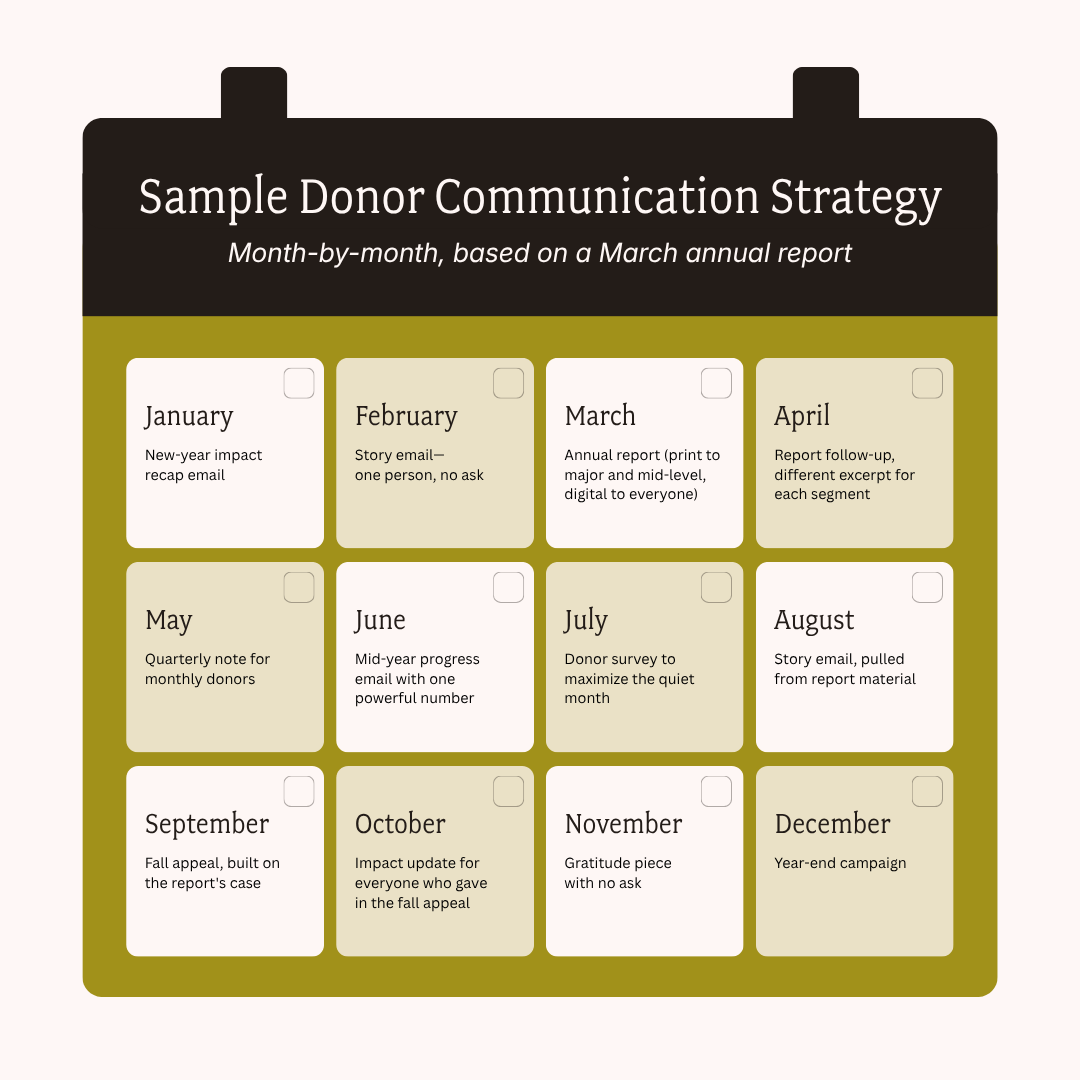
Feel free to download and adjust accordingly based on your report publication month! Or check out our Annual Report Planner if you're looking for a fully customizable planning system to help organize your data and keep production schedules in check.
5. Measurement
Once the plan is laid out and running as you want it to, the last step is making sure that you're seeing the results you expect.
Review your metrics quarterly, not at year-end when it's too late to fix. Your indicators will depend on the goals you set, but the following are the most common and useful:
- Retention rate by segment
- First-to-second gift conversion
- Days until you receive the second gift
- Gifts per donor per year
- Donor recognition (add one question to your next donor survey: "Did you know this was from us before you read it?")
Design-Focused Donor Communication Best Practices
A good, thorough donor communication plan can still fail if the materials you're using to communicate aren't connecting.
So, let's talk about the tips CRM and fundraising strategist probably will skip over.
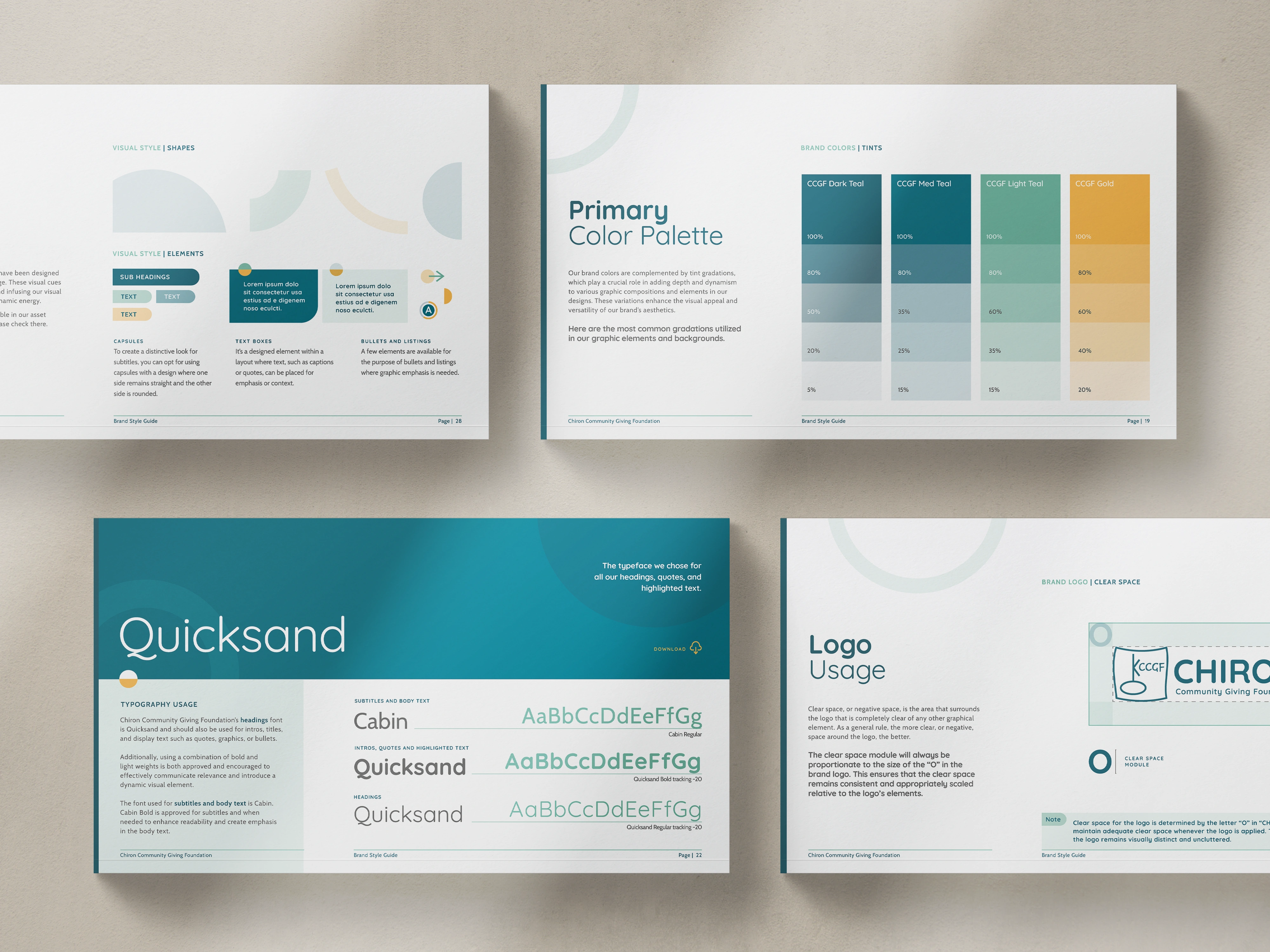
Find one visual system and enforce it
Two typefaces with defined sizes, a five-color palette with assigned roles, one photo treatment, one chart style, one logo lockup. Write it down.
A simple but recognizable brand kit is better than bold visuals that change every month. To make it easier for your team, set the default colors and font on your email platform and org Canva account, so no one has to make an on-the-spot design choice at 4:45 pm.
Set the type for the donor base you have
If your nonprofit donor base skews older, your beautiful 9pt body copy is going to be unreadable to many of your best givers. Go for a minimum of 12pt for print body copy, 14pt if your file skews over 60. Color contrast has to be at least 4.5:1.
And while we're talking accessibility, don't forget that over half of nonprofit web traffic comes from mobile devices. If your annual report is a print PDF with 10-column financial tables, your mobile readers get nothing.
Give your numbers a form
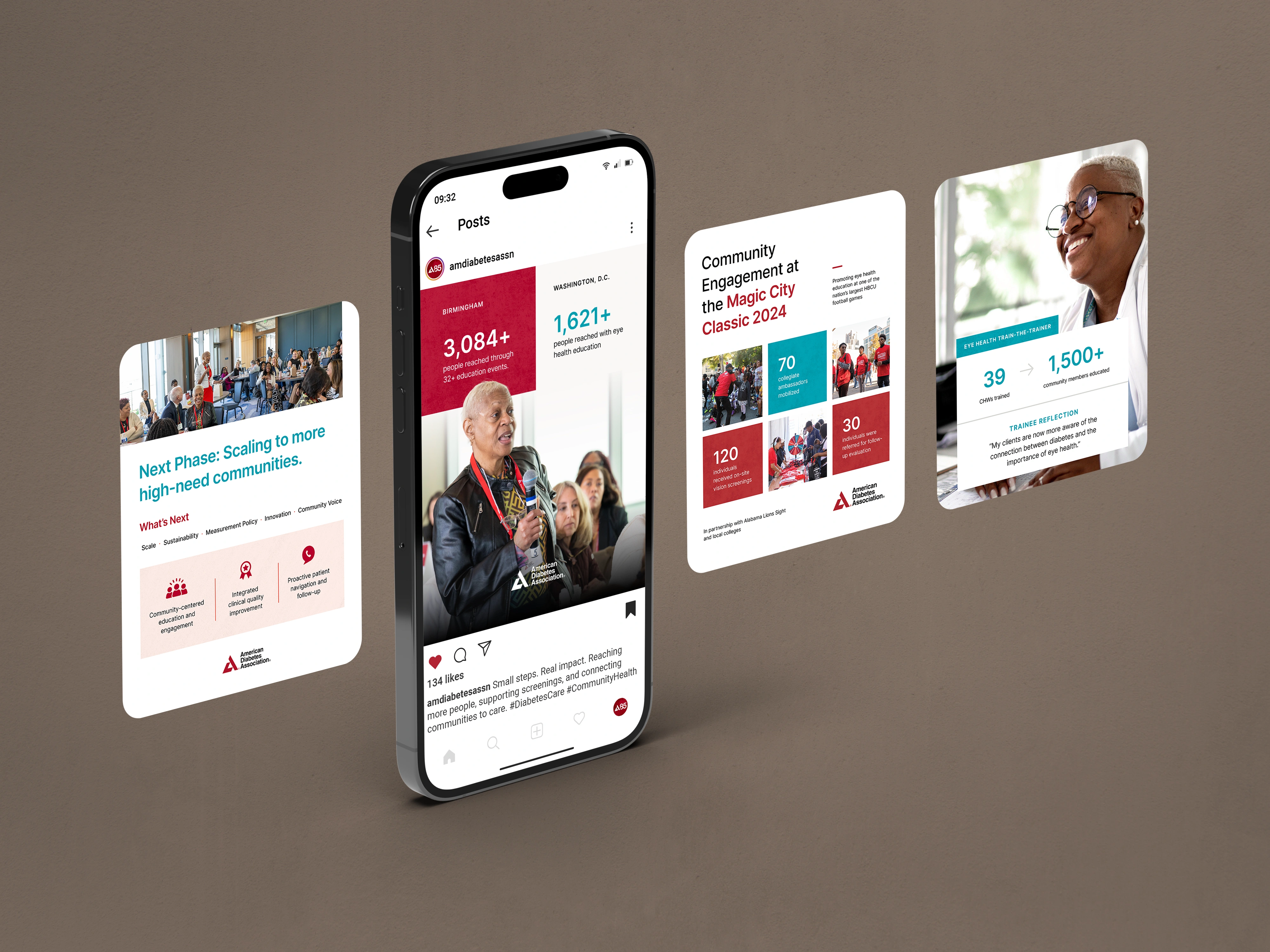
A stat in a paragraph is a stat nobody remembers. The same number, set large with one line of context under it, is the thing a donor repeats to their family and friends.
Keep the numbers that change out of the printed piece
If you want regional breakdowns, program-level participation, or anything you'll want to revise in the next six months, put a short link or a QR code in the report and point it at a landing page you control.
The report stays skimmable, the data stays current, and you can update it yourself without reopening a design file.
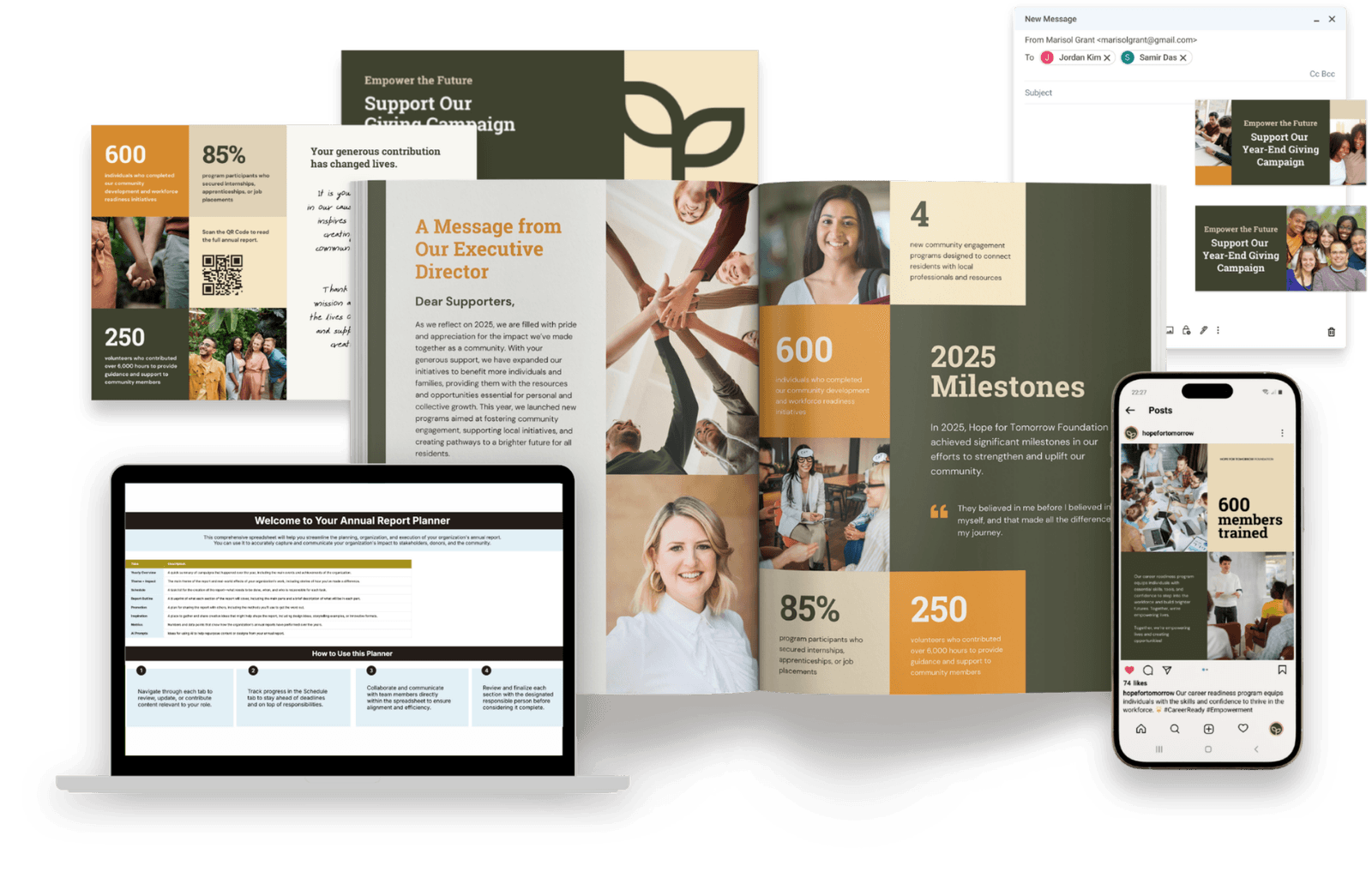
Make it recognizable before a single word is read
A donor should know a piece is from you before they process a single word. That's donor recognition, and recognition builds belief.
The Donor Communication Strategy You Can Sustain
Building a fully thought-out comms strategy feels like a lot… because it is. Your stewardship and fundraising depend on how well you can stay connected with your donor base and earn their trust, so creating and sending the materials to do is a big task.
Doing it fresh every year means constantly being on experimenting mode. And you don't want to gamble the belief you've worked so hard to build over the years.
Instead, follow these 3 simple tips:
Start with one source document
Skip the blank page by reframing your entire comms strategy around one document.
Your annual report is the only place where your org systematically gathers outcome data, new photography, beneficiary stories, and financial clarity all in one place. It takes months to work on… and then most orgs publish it, post it, and archive it.
That's the most expensive content in your organization, used once.
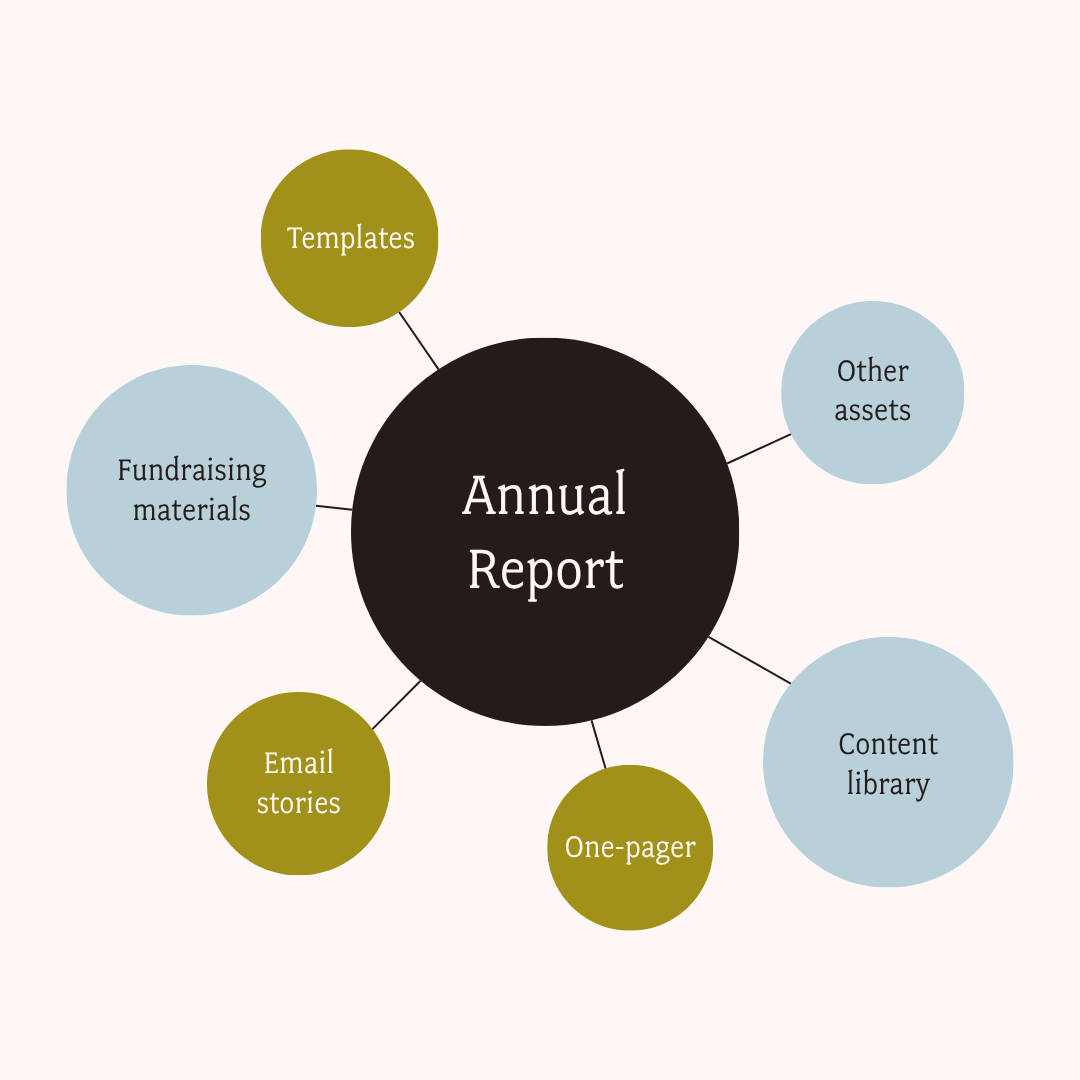
One report can contain: email impact stories, donor updates, social posts, your appeal letter insert, the major-donor leave-behind, most of your grant boilerplate, your website's impact page, and the first eight slides of every deck you'll build until next fall.
Instead, build the report as the source, so the year's comms plan is just waiting to be scheduled (instead of written from nothing).
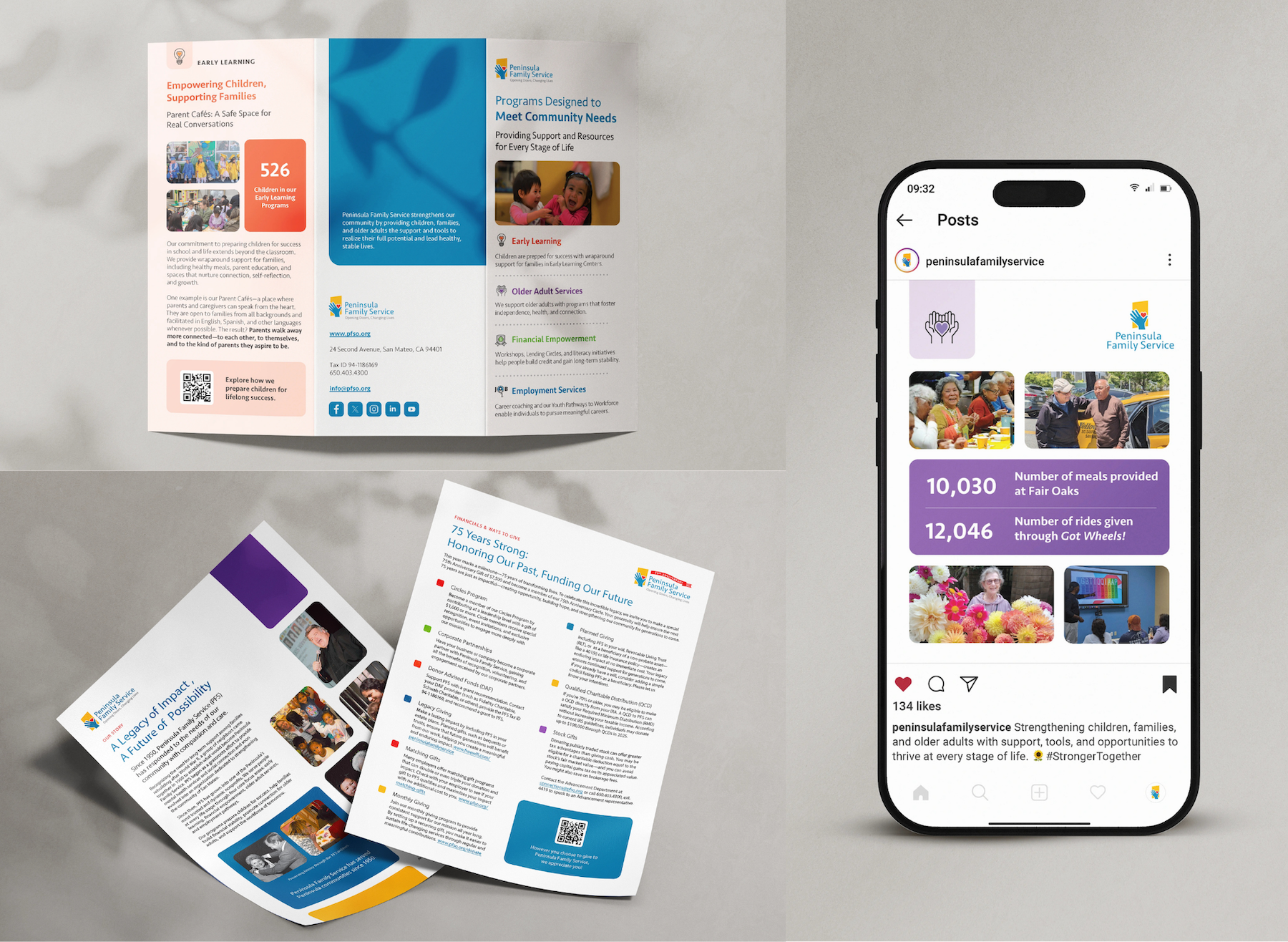
That's what we did for Peninsula Family Service's Annual Report for their 75th year.
One animated, interactive PDF for email and social media and over 15 digital assets: social graphics, email graphics, infographics, one-pagers and donor outreach materials. This way, their anniversary could be celebrated all year, not just during the week the report was released.
Build it so next year isn't a rewrite
Put the year-specific data on a removable center spread. Four or eight pages, in the middle, holding the case counts, the financials, the numbers that are true about this year and only this year. Everything around it stays evergreen: who you are, what you do, the stories, the ask.
Which means in March, you have a full annual report. In September, when a program officer asks for something, you hand over a document that is still accurate. And next year, you rebuild eight pages instead of forty.
The same logic works digitally. Think dropdowns or a page you swap out.
Reports usually go stale on a date rather than gradually, and it's almost always because the perishable content got mixed evenly through the evergreen.
Create a framework that can be run by two people
Your strategy is only as good as your capacity to implement it. If your plan falls apart the moment the org hits a busy season, it's not a plan at all. Build your plan so it survives, even if only two people are left to follow through.
Batch the writing. Pull the year's email stories out of the report in one sitting in April instead of doing it 18 hours before each newsletter goes out.
Build templates once. Create two email templates: a print insert layout, a one-pager. Every piece after that is content entry, and you don't have to redesign each time.
Shoot photos on a schedule. One photographer, one afternoon, twice a year. With a shot list written before you show up. That solves the image problem for the entire year.
Cut something. Plan around what you can actually achieve. If you can't produce twelve quality touches out of a report, produce eight. Nobody has ever unsubscribed because a nonprofit sent them one excellent thing instead of four rushed ones.
FAQs: Building an Effective Donor Communication Plan
What is a donor communication plan?
A donor communication plan is a dated schedule of what each donor segment receives, through which channel, and in what format. It's rolled out over twelve months and tied to specific retention and upgrade goals.
How often should you communicate with donors?
Most nonprofits send a monthly newsletter and quarterly appeals, which is a reasonable floor. The better metric is the ratio: aim for at least two thank-you or impact touches for every ask.
What's the difference between donor communication and donor stewardship?
Donor stewardship is the relationship strategy. Donor communication is the set of materials that carries out that strategy. You need both, but most orgs have planned out the first and improvised the second.
How do you communicate with major donors differently?
Physical over digital, specific over general, and personal over institutional. A major donor should receive something naming what their gift funded, signed by a person they've met.
How do you measure whether donor communication is working?
Look at the retention rate by segment first. Everything else, opens and clicks included, is a leading indicator of that first number.
Annual Reports Made for Year-Round Communication
Print the last five things you sent a donor. Put them side by side.
Do they look like they came from the same organization? Would a donor recognize the fifth one without reading it?
If the answer is no, you've got a design problem that no amount of strategizing can fix.
Acton Circle specializes in annual reports that are built to be taken apart to fuel a year's worth of fundraising and marketing content.
Book a call today to talk about where your last report went wrong and how we can make the next one your best yet. If we're a fit, you'll know. If not, we'll tell you that too.